Wipe Out: World’s Most Vulnerable Coastal Cities

09/2/09  Print This Post Print This Post    12 Comments   Popular   Written by Julie Schwietert
    Share

The real scenario will be far more frightening than anything we can Photoshop. Photo: Cherrylynx

What’s the back-up plan for those of us who live in one of these cities?

Yesterday, I was listening to The Brian Lehrer Show, a program on my local public radio station here in New York City. One segment featured scientists Rob Young and Orrin Pilkey, authors of the recently published book, The Rising Sea.

Young and Pilkey, climate change specialists, spoke about the 10 cities they deem most at risk from sea level rise caused by climate change. The cities are:

1. Miami, Florida, USA

Miami is the seventh largest city in the United States, so any abrupt sea change here would impact the lives of millions. Average elevation? Just six feet.

A Miami blogger, citing a July 2009 New Scientist article, wrote recently that even rapid action to decelerate climate change is unlikely to prevent an inevitable swallowing up of Miami by the sea. Instead, he argued, the only logical plan B for the city is to stop building in vulnerable areas…which is almost everywhere.

2. Venice, Italy

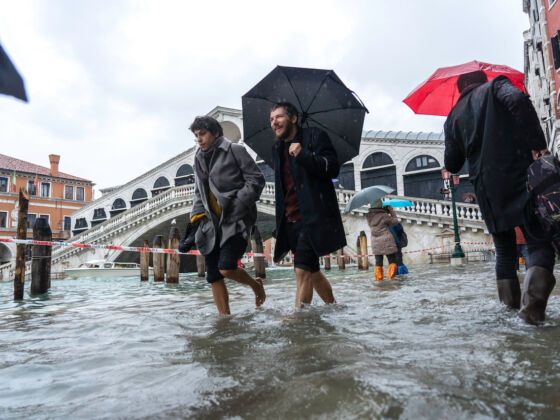
Venice is known as the city of water for good reason. Since 1897, the mean sea level around Venice has increased by three inches. That may not sound like much over a period just a shade longer than a century, but coupled with the phenomenon of sinking land, the public television show NOVA has referred to Venice as a city under environmental siege.

3. New York, New York, USA

What would New York City be like under water? Scientists predict that we may find out far sooner than anyone expected. According to this article from Science Daily, “Global warming is expected to cause the sea level along the northeastern U.S. coast to rise almost twice as fast as global sea levels during this century,” putting New York City at particular risk.

4. Mumbai, Maharashtra, India

Mumbai is one of the world’s most densely populated cities, which makes predicted sea change effects here particularly frightening. Besides the fact that many parts of the city are just 46 feet above the Arabian Sea, Mumbai is known to have a poor drainage system and–as if that wasn’t enough–it’s located in a major seismic zone.

Low elevation+poor drainage+seismic zone+rising sea levels= inevitable disaster.
5. Singapore

Singapore was accurately described by The New York Times in 2007 as “surrounded by sea and almost pancake flat.” Though its highest peak is 540 feet above sea level, the vast majority of inhabited space is just a few feet above sea level. The inevitable slip into the sea is being addressed by the government, which has reached out to Dutch dam-building experts to help reinforce the Singaporean sea wall.

6. New Orleans, Louisiana, USA

The vulnerability of New Orleans to the whims of the ocean was laid painfully bare by Hurricane Katrina. The highest point in the city is only six feet above sea level, and being surrounded by water, the future of the city in the event of even a minimal sea level rise is likely to be catastrophic.

7. Osaka, Japan

How’s this for a sobering statistic? The Intergovernmental Panel on Climate Change predicted that a mere one meter rise in sea levels “would swallow about 90% of the sandy beaches in Japan and 100% of the sandy beaches in
Osaka.”

8. Tampa/St. Pete, Florida, USA

Sea levels in Tampa/St. Pete have been rising at a clip of an inch a decade since the 1940s.

9. Dhaka, Bangladesh

Dhaka, Bangladesh’s capital, is another one of the world’s 10 most populated cities and one of its most low-lying.

10. Tokyo, Japan

At just 16 feet average above sea level, Tokyo rounds out the list of the world’s cities that are deemed most vulnerable to rising sea levels caused by climate change.

The common feature of all 10 cities is their low-lying elevation. For more of the science behind this list, listen to the podcast of this segment here:

Community Connection:

Carly Blatt’s “How to Survive Travel Disasters: Lessons From Hurricane Katrina” isn’t just relevant for travelers; it includes some useful emergency planning tips for those of us who live in low-lying and catastrophe-prone areas, too.


    Share

About the Author

Matador ID: collazo

Julie Schwietert is the managing editor of Matador Network. She contributed a chapter to the recently published book, The Voluntary Traveler, and is currently working on five features for Fodor's Puerto Rico, 6th Edition.

12 Comments... join the discussion!

  • Melvin replied on September 2, 2009

    You are forgetting half of the Netherlands here! Especially Amsterdam!
    The dutch are the best dam builders…

    (Report comment)

    ↵ Reply
  • Julie Schwietert replied on September 2, 2009

    Hi, Melvin-

    I was just posting the list of the most vulnerable cities as determined by the two climate change scientists mentioned in the opening of the article.

    (Report comment)

    ↵ Reply
  • Reeti replied on September 2, 2009

    Hi Julie!

    a very thought-provoking article. Thanks for sharing :)

    (Report comment)

    ↵ Reply
  • Megan Hill replied on September 2, 2009

    We’re so screwed…

    (Report comment)

    ↵ Reply
  • guncoon replied on September 2, 2009

    Hello? Capetown?

    (Report comment)

    ↵ Reply
  • Frank replied on September 2, 2009

    Especially sobering for those of us in the US, considering how terribly FEMA handled New Orleans when the levees broke.

    (Report comment)

    ↵ Reply
  • Kathy replied on September 2, 2009

    Something of a relief not to see Houston on the list but it would have to be in the next 10.

    (Report comment)

    ↵ Reply
  • alan replied on September 2, 2009

    Wow, almost half of the cities on the list are located in the US. All the more reason to turn it around.

    (Report comment)

    ↵ Reply
  • eileen replied on September 3, 2009

    I half-expected to see Chile’s Valparaíso on the list, but then I remembered that that’s more likely to get wiped out in a tsunami. Scary stuff, all of it. But who can blame human beings for wanting to live close to the water? So practical, so calming!

    (Report comment)

    ↵ Reply
  • Chris replied on September 14, 2009

    Interesting article. How about Male, capital city of the Maldives? I definitely think that should be in the top 10.

    (Report comment)

    ↵ Reply
  • Christine replied on September 14, 2009

    I actually know a couple of people who have left San Francisco in the past few years because they believe it is going DOWN.

    (Report comment)

    ↵ Reply

Leave a Comment

Get Matador in your inbox and around the web.

Sign up for our FREE weekly newsletter.


View full list of RSS feeds

Jump To Category:


Explore the Community


Popular Stories on Matador

Love in the Time of Matador: Drawing Our Own Ghosts

Angela Tung explains how a Buddhist monk helped her lea... 

How Climbers Can Help Pakistan Rebuild

A senior official at the Red Cross has said that rebuil... 

Dating Tips From Around The World

Be careful buying someone a drink in Norway; watch out ... 

Why Would Anyone Ever Want To Leave America?!?

I’d love this country if it weren’t populated with ... 

Photo Essay: People Watching in Verdi Square, New York City

The comings and goings of people at Verdi Square, in th... 

Notes on Codification and Commodification in Travel Writing

Because codification enables a "common frame of referen... 

9 Facts About Micro Four Thirds Cameras

Documentary photographer

Finca Bellavista: The World's First Treehouse Subdivision

With sustainability as a guiding principle, Finca Bella... 

20 Best Beer Towns in America

. . . nothing wrong with choosing your next travel dest... 

10 Tips for Becoming a Location Independent Professional

Location independent jobs are becoming more commonplace... 


Focus


Blogroll


Editor Blogs