The Happy Planet Index: Finding Happiness Without Destroying the Earth

09/8/09  Print This Post Print This Post    8 Comments      Written by Carlo Alcos
  • Stumble It
Costa Rica

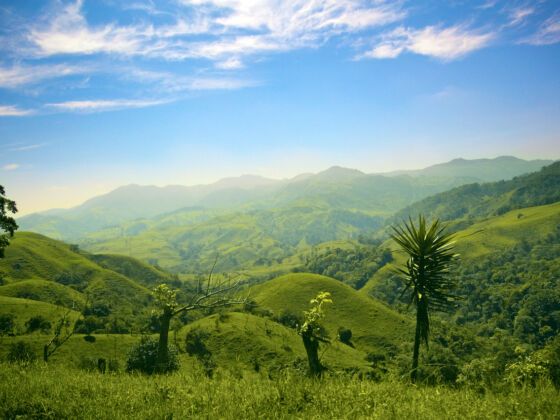
Costa Rica / Photo: Wha’ppen

Happiness and long life expectancy don’t have to cost the earth.

In a recent article at Brave New Traveler, I discussed 5 Key Ingredients in the Search for Happiness. What I didn’t take into account was the planet we live on. Can we be satisfied, live a long life, and be good to the earth?

The Happy Planet Index (HPI) doesn’t solely indicate people’s happiness levels. It measures happiness levels in relation to a country’s consumption of its natural resources. Its aim is to prove that you can be happy without raping the planet. From the HPI website:

The nations that top the Index aren’t the happiest places in the world, but the nations that score well show that achieving long, happy lives without over-stretching the planet’s resources is possible.

What is the HPI?

2009 is the second year that the Index was put together. It was started by the new economics foundation (nef) — an independent think-and-do tank — whose tagline is “economics as if people and the planet mattered” and who explains their goal as such:

We aim to improve quality of life by promoting innovative solutions that challenge mainstream thinking on economic, environmental and social issues. We work in partnership and put people and the planet first.

Obviously, the HPI takes into account several factors and by its nature is subject to debate, given that quality of life is a subjective factor. In the end, the HPI measures well-being delivered per unit of environmental impact.

A country achieving a maximum life satisfaction score of 10, and life expectancy of 85, whilst living within its global fair share of resources (one-planet living), would score 100.

For detailed information about how the HPI is calculated, you can view the full report here.

The results

So just what country is the happiest while doing its fair share in ensuring a happy planet? Costa Rica.

Costa Rica scored a 76.1 on the HPI for its high levels of life satisfaction, long life expectancy and low ecological footprint (one-quarter that of the United States). Second and third go to the Dominican Republic and Jamaica, respectively. In fact, nine out of the top ten nations in the HPI are Latin American.

At the other end of the spectrum, rich and developed nations fared poorly. Out of 143 countries, the highest ranking Western nation is the Netherlands at 43rd. The UK sits at 74th. And where exactly is the USA in this Index? 114th. While the Dutch only live on average one year longer than Americans and have similar life satisfaction, their ecological footprint is half that of the US, accounting for the significant difference in ranking.

What does it all mean?

I think that many of us living in rich, developed countries already had an inkling that we might not fare well in something like this. While life expectancy may be improving (Canada is ranked number one there) due to medical advances, life satisfaction is on the decline as we sacrifice things that are important to us — family, friends, time — in the chase for money and career progression.

Add to that the enormous amounts of resources we use, much of which is non-renewable, and the low rankings are inevitable.

It’s becoming more and more evident that our current economic models which rely on infinite growth and which don’t factor in the environment aren’t working. If we become rich at the expense of the planet, what good is that? The HPI is a refreshing and practical measurement which balances our health, quality of life, and our effects on the earth. This is the new economics.

COMMUNITY CONNECTION

Journalist Eric Weiner circled the globe in search of the world’s happiest countries. Read a review of his book, The Geography of Bliss, here.


  • Stumble It

About the Author

Matador ID: vagabonderz

Carlo (not Carlos) is a contributing editor of Matador Trips. An ex-Vancouverite who calls the world his home, he is currently living in Melbourne, trying to crack the code to sustain the vagabonding lifestyle with the least amount of work possible. Follow him at his blog here...I mean, here.

8 Comments... join the discussion!

  • Hal replied on September 8, 2009

    Wow. 43rd for the highest developed Western nation. Shows you how we got to where we are.

    (Report comment)

    ↵ Reply
  • Ryukyu Mike replied on September 8, 2009

    Cool, I went and checked your Links and got lost for an hour !

    (Report comment)

    ↵ Reply
    • Carlo Alcos replied to Ryukyu Mike on September 8, 2009

      I know exactly how you feel. Lots of interesting info in those and it always leads to more!

      (Report comment)

      ↵ Reply
      • Ryukyu Mike replied to Carlo Alcos on September 8, 2009

        Then, with this Stumble thingy I got and Tweets and not nuf coffee, typin’ keys stickin’; it’s a jungle in here !

        (Report comment)

        ↵ Reply
  • Eva replied on September 9, 2009

    Jamaica and the DR, for serious? I thought they were supposed to be two of the worst examples of the typical Caribbean tourism-based economy – high-priced resorts and big spenders inside the walls, severe poverty (and at least in Jamaica’s case, substantial violence, often drug-related) outside. Never figured that’d be a recipe for happiness, or long life expectancy. Wow.

    (Report comment)

    ↵ Reply
    • Carlo Alcos replied to Eva on September 9, 2009

      Here are excerpts from the report (link above in article) on DR and Jamaica:

      DR:
      Whilst the Dominican Republic’s condition is similar to many other countries in the region – a medium score in the Human Development Index, dependence on the USA for trade, relatively high life expectancy given its income levels and, high levels of inequality – unlike many of its neighbours it manages to achieve a life expectancy of over 70 years with a very small footprint.

      Jamaica:
      Jamaica’s appearance in the top three of the HPI table comes somewhat as a surprise. It is fair to say that the country has been in some economic trouble for over 30 years, resulting in high levels of inequality and unemployment, and some of the highest homicide rates in the world. Moderate levels of life satisfaction perhaps reflect this reality.
      And yet, despite these problems, the island is able to maintain some of the best levels of health in the developing world, as indicated by its high average life expectancy. Together with its very small ecological footprint, it is this which puts Jamaica towards the top of the HPI table.

      (Report comment)

      ↵ Reply
  • Nick replied on September 9, 2009

    “An independent think-and-do tank — whose tagline is ‘economics as if people and the planet mattered’”… I LOVE this. Inspiring stuff!

    (Report comment)

    ↵ Reply
  • Carlo Alcos replied on September 9, 2009

    This is interesting, it’s part of the conclusion in the report (if you don’t feel like opening the PDF):

    “Latin America. Let’s not beat about the bush. The region has had, and continues to have, its fair share of misery: decades of civil wars and coups, the destruction of the Amazon, sharp inequality, and the favelas and slums of metropolises from Mexico City to Sao Paulo. For some, the region represents a sad tale of lost opportunity. In 1900, Chile, Argentina and Mexico all had higher per capita GDPs than Japan. Even Colombia’s GDP per capita was only half that of Italy’s or Norway’s (nowadays it is behind by factors of four and six respectively). But, while Italy, Norway and Japan have all strengthened into rich and relatively equal societies, Latin American countries have, for the most part, fallen down the list of the richest countries.

    And yet, the top two sub-regions in terms of the HPI are those of Latin America. What sense can we make of this success? Are Latin Americans as happy as they say they are? And what, if anything, can the rest of the world learn from Latin America?

    Survey data reveals two key features of Latin American culture. One is the presence of relatively unmaterialistic aspirations and values, compared to countries with similar economic conditions. Latin Americans report being much less concerned with material issues than, for example, they are with their friends and family. Secondly, social capital is particularly strong in the region. Civil society is very active, from religious groups to workers’ groups to environmental groups. The data on ‘formal’ social capital is reflected in anecdotal evidence of informal social capital in terms of strong family and community ties.

    We have already seen, in Chapter 3, how these two factors – non-material aspirations and social relations – are crucial to well-being. In Latin America, they combine to create a society that is able to rise above economic hardships, whilst drawing great benefit from its social links. It is worth noting that, despite a poor economic record in terms of average income and an even poorer record in terms of inequality, Latin America still enjoys levels of health that are close to those of Central Europe and often superior to Eastern Europe. As well as reasonable state provision in many countries (e.g., in Colombia almost half of the country’s 44 million people enjoy free public health care), this is likely to be in part due to strong social networks forming a safety net for those who are less fortunate.

    Some have mocked the high levels of reported life satisfaction in Latin American countries as belying a lack of knowledge of anything better (i.e. Western lifestyles). On the contrary, Latin America is perhaps more exposed to North American culture than anywhere else in the developing world. Yet somehow it has been more resistant to idolising this lifestyle, or at least more able to be happy with its own way of life despite this influence. Pura vida is a popular expression in Costa Rica which is used somewhat like the English term ‘cool’. It translates literally as ‘pure life’ and represents in itself an attitude to what is important.”

    (the bolding is mine)

    (Report comment)

    ↵ Reply

Leave a Comment

Jump To Category:


Explore the Community


Latest Community Blogs

  • Right after our plane touched down in the runway of the Dumaguete City airport, at the capital of the Negros Oriental pr...
    » posted on 7 February 2010
  • Community Forge keeps a blog aimed its few donors and supporters.http://www.communityforge.net/donorblog...
    » posted on 4 February 2010
  • If you are in New Zealand on a travelling holiday try to catch the More FM Winery Concert Tours somewhere along its way...
    » posted on 7 February 2010

Popular Stories on Matador

7 Reasons To Travel With One Bag

... 

30 Funny Travel Quotes To Make You Smile

A collection of classic travel quotes to sharing lighth... 

8 Incredible Survival Stories

Eight of the most amazing tales of survival ever writte... 

Top Gadgets To Travel With In 2010

With newer, ultralight, razor-thin, lightning-fast, adv... 

"Daggering" in Jamaica: A Dance Craze Gone Too Far?

The spiraling popularity of "daggering" -- a "lewd" dan... 

The Dude Abides: The Meaning of 'The Big Lebowski' Ten Years Later

... 


Focus


Blogroll


Editor Blogs