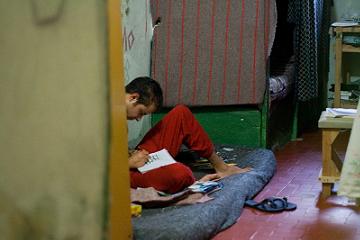
Photographers Michelle Ferng and Danny Thiemann share photos from their project documenting life in Brazilian prisons.
Michelle and Danny explain the impetus for their documentary project:
Our job was to capture the stories and images related to prison life, the city streets, the courtrooms and the debates shaping the future of Brazil’s legal reform.
It wasn’t easy.
Our opportunity in Brazil was organized by International Bridges to Justice (IBJ), an organization open to young travelers who would like to use their skills in documentary photography or writing to assist programs in the developing world.
In July of 2009, International Bridges to Justice (IBJ) sent us to Brazil to assess the impact and potential of IBJ’s fellowship program there. The program, known as JusticeMakers, granted Dr. Aziz Saliba the financial support to produce an educational DVD on habeas corpus and the Inter-American Court.
Every prison that IBJ’s team visited was at least twice over capacity, except for one- APAC (Associação de Proteção e Assistência aos Condenados). This prison is Brazil’s homegrown vision of a jail guarded by prisoners themselves. It was the cleanest, most cost-efficient, spiritual and calm prison we’d visited during our stay. The energy and the optimism of the lawyers we worked with kept us going.
The surreal characteristic of the other prisons we visited reminded me of Ursula K. LeGuin’s famous story, “Those who walk away from Omelas.” But on the whole, I was most struck by the humor and the optimism of people like Adão, a spiritual leader in a community with high incarceration rates; Thomas, a young boy of 15 who knew his rights front and back; Lupe, a man who had re-written a book about his life in prison memorized completely in his own head; Roberto Tardelli, a leading prosecutor who worked in neighborhoods where locals thought they were still under the military dictatorship of the 1970s; and Casé, a lawyer leading the campaign against pedophilia and child abuse who still had time for his own love of comic books and family.
These people all have their own stories.
I hope our photos encourage you to learn more about their situations, help their cause, or join IBJ in the future.
To learn more about the documentary journalist positions at International Bridges to Justice, please visit this site.
If you’d like to make a donation to the habeas corpus project, please click here.
If you’re interested in volunteering with an NGO in Brazil, please contact Cecilia Neves Silveira at cecilia@omnes.org.br. Cecilia coordinates opportunities at OMNES, an NGO working with the defense of human rights as a whole. Projects include teaching professionals how to work with the human rights legal system. Another project assists prisoners and defends their rights.
Cecilia also coordinates volunteer opportunities at De Volta Para Casa, an NGO helping children return to their homes or to help them find families. De Volta Para Casa also works with children in adolescent prisons.
1
Sun and recreation
Prisoners are given time during the day to sunbathe in a courtyard at Presidio Floramar, an adult prison located in Divinopolis, Brazil. They are required to sit during this period until the head count is completed. Meanwhile, some chant, sing to themselves, or talk with the guards, but are on the whole much quieter than the inmates at the adolescent jail next door.
2
Female guard
Though Floramar is considered to be one of the more well-managed prisons in the region, it suffers from the characteristic overcrowding that affects most prisons throughout the country. At approximately 500 inmates, the prison is already over twice its formal capacity of 250 inmates. Even so, grievances are hardly addressed. Fire riots broke out at Floramar due to overcrowding just weeks after this photo was taken, eventually put down by brute police force.
3
The stacks
The Brazilian justice system is plagued by a number of serious problems, most notably, a lack of investigators and endless bureaucratic red tape. A single case could take up to 10 years to process. Here, an employee files away paperwork for a case at Forum, a civil and criminal courthouse in Divinopolis, Brazil.
Intermission
4
Overcrowding
Under such circumstances, many temporary detention centers have been converted into full time prisons for both accused and convicted criminals. This alberque, living quarters originally meant for accused individuals imprisoned for a maximum of 30 days, is located just outside of Divinopolis. Like Floramar, it is also twice over capacity, at 50 inmates in a 25-person facility.
5
An inmate writes a letter
One inmate we spoke with had been detained for two years and three months. Though he suffered from severe medical conditions, including a tumor, he was still awaiting trial. Most inmates spend their free time writing letters to friends and family.
6
Female inmate
IBJ Fellow Dr. Saliba is hoping to inform these prisoners of their right to habeas corpus, which would protect them from illegal detainment. Through the distribution of a short film, he can make a difference by making it easier for people to both learn about their right to habeas corpus and for communities to exercise this right more often. As such, the film is directed toward a lay audience with no experience in law or legal training. Dr. Saliba is also producing a second film for legal aid workers on the Inter-American Court of Human Rights â a resource they could appeal to when all else fails.
7
Narration
Faical narrates Dr. Saliba's film on habeas corpus. As the General Director of Universidade de Itauna, a law school in a nearby city, he has been assisting Saliba as he approaches completion of his project with International Bridges to Justice.
Intermission
8
Prisoner escort
The road ahead is still long. Weak institutions and bureaucratic inefficiency are only two of a host of obstacles that Brazil faces. Most prosecutors we spoke with in Brazil agree the legacy of the military regime is a major cause for the gaps they face in the fair application of Brazilâs legal code. The stigmatization of Brazilian human rights commissions, historically related to criminals and those on the margins of society, means that society as a whole is less willing to embrace human rights reform and debate. Above: Two security agents accompany an inmate down the halls of Forum, the civil and criminal courthouse in Divinopolis.
9
Race relations
Continued racial profiling and troubled state-society relations can also make people reluctant to learn about their legal rights. In this photo an inmate consults with his lawyer beside Floramar's open courtyard, defying the traditional stereotypes of social class and race. To this day, many Brazilians question the authority of the police, largely as a legacy of the decades of military dictatorship.
10
Inmate smiling
Nonetheless, progress is being made, albeit very slowly. A new form of detention is now being implemented in Brazil and worldwide -- one that focuses on the prisoner as a human being with dignity and potential rather than as a mere prisoner. In many ways that addresses the plight of the Brazilian legal system, especially with regard to its historical legacy and social stigmatization. The system, known as APAC (Associação de Proteção e Assistência aos Condenados), boasts success on all accounts, from reeducation rates to financial sustainability standards. Above: an inmate looks out the window from an APAC office, where all of the administrative work is carried out by inmates.
11
Saying goodbye
Imprisonment does not dampen the youthful spirits of inmates, as one young man reaches out spontaneously to pose for the camera.