Dollars vs. Danger in the Caribbean

07/14/10  Print This Post Print This Post    12 Comments   Popular   Written by Julie Schwietert
    Share

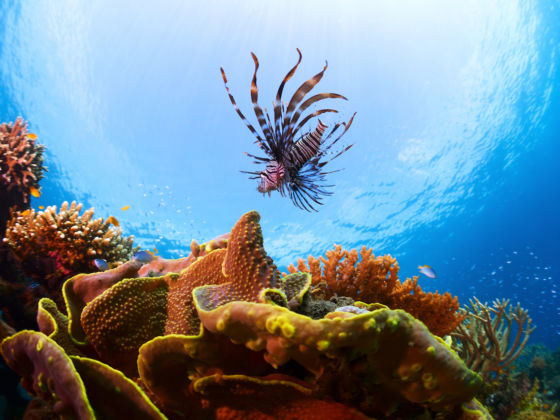
A lionfish: both beautiful and dangerous. Photo: tibchris

“And what about the lionfish?”

That’s what the person on the other end of the line asked after the teacher passed her cell phone to me.

I was about to take 20 of her students snorkeling a mile or so offshore in La Parguera, Puerto Rico and her husband was calling to ask if I’d heard about the invasion of lionfish plaguing the area.

I hadn’t.

The caller–the teacher’s husband–related that he’d heard some lionfish had escaped from an aquarium in Florida. They’d recently been spotted in the Caribbean, and allegedly in the area where we’d be snorkeling.

As the group put on their swimsuits and slathered high SPF sunscreen on each other’s backs, I ran up to the shop where our local outfitters were based. “Carlos*,” I said, hugging the divemaster I’d known for five years. “Y que con el pez leon?”

Carlos might as well have been born in the water. He’s got a shark tattooed on his shoulder. He leads snorkel and dive trips all day, every day, but his free time is still spent on his boat. For a long time, he even lived in a house perched on stilts–in the water.

On the water, at least, I trusted him with my life.

“Nada,” he said, asking me about my husband, my daughter, what I’ve been up to since I saw him last July.

After the small talk, I pressed him again, just to be sure. “En serio, have you guys seen lionfish out there?” “Out at La Pared, yes,” he answered, referring to The Wall, a popular deep water dive spot a few miles offshore. “But not where we go. Todo bien.”

He winked.

*
Sometimes, if the kids aren’t strong swimmers, I’ll stay on the boat. Though the outfitters are attentive, teenagers stray; they get tired easily and overestimate their strength. When this happens, I can see them, jump in the water, and swim them back on track. Or haul them in.

But maybe I stayed on the boat this time because of the lionfish?

“Jim, I’ve got a question for you.” The captain, an American guy I hadn’t worked with before, lowered the Jimmy Buffett. “Shoot.”

“All kinds of little lies are told here. Without them, the travel industry here would collapse.”

“So is the lionfish out here?” “Yeah,” he said, almost without feeling. “It’s here.” He went back to the cabin. In a minute, Buffett’s washed out voice filled the quiet.

*
I saw Carlos dive down deep and surface again, a massive sea star in his hand. This is why he’s great with kids; he shows them a new world, gets them excited about it. He helps them confront their fears and he tells them “I’m proud of you” when they swim through that fear and pop up on the other side. Though neither of us will ever see these kids again, I know that their time with him changes them. They’re more self-confident. More brave. More willing to try new things.

If he told me about the lionfish, he knew I’d tell them the truth. And if I told them that truth, it would change everything. They’d sit on the boat, minds swimming with images of schools of lionfish.

And so he lied.

In La Parguera. Photo: Francisco Collazo

He lied, too, because this–showing people the sea–is his living. In a very real way, it’s the sustenance of the entire town. Described in guide books as a “quaint fishing village,” if you visit more than once or stay a lot longer, you know things are more complicated than that. All kinds of little lies are told here. Without them, the travel industry here would collapse.

As it would elsewhere.
*
The danger of the lionfish is real, but the National Geographic Society notes that a lionfish’s sting is “rarely fatal.” Excruciatingly painful, yes. But rarely fatal. Rarely. Hardly a comfort to people already frightened about the mysterious sea.

So we lie, Carlos and I.

__
*all names have been changed.

Community Connection:

Far more dangerous than the threat of lionfish to snorkelers and divers is the threat these invasives pose outside their home environments. To learn more, visit REEF.org.


    Share

About the Author

Matador ID: collazo

Julie Schwietert is the managing editor of Matador Network. She contributed a chapter to the recently published book, The Voluntary Traveler, and is currently working on five features for Fodor's Puerto Rico, 6th Edition.

12 Comments... join the discussion!

  • Michelle Schusterman replied on July 14, 2010

    Wow – chilling. I can completely understand your position, though, and Carlos’ as well.

    (Report comment)

    ↵ Reply
  • Jason replied on July 14, 2010

    I’ve never heard of lionfish, but I have to admit that Carlos’ estimation of what the casual diver might think of is dead-on. I wouldn’t be anywhere near the water. But perhaps this isn’t as dissimilar from any other kind of area with real threats. Cities have nothing-to-lose criminals and violent muggers, the wilderness has its natural dangers.

    (Report comment)

    ↵ Reply
  • Doug replied on July 14, 2010

    I suspect there are different species of lionfish with different behaviors in many parts of the world, but the ones I have encountered in the Red Sea are not aggressive, keep their distance and are instantly recognizable…….as if to say, keep YOUR distance Dude.

    It is hard to come into contact with them on a daytime dive/swim/snorkel. If you do, you should immediately get thee to a clinic on land, as it takes 4 hours for the sting to be fatal IF it is going to be fatal. Why take chances?

    But otherwise, not much to get unnerved about.

    (Report comment)

    ↵ Reply
    • Julie Schwietert replied to Doug on July 14, 2010

      Doug-

      After the trip, I did some reading about the lionfish, and you’re right. They’re actually quite shy, as is the case with many venomous animals. But as with jellyfish, or sharks, or any other animal that has come to be perceived as threatening, it’s hard for many people on these trips–especially kids–to have a rational conversation about the relativity of danger.

      (Report comment)

      ↵ Reply
  • eileen smith (bearshapedsphere) replied on July 14, 2010

    I’m curious to know if you thought at any point of pulling the plug on the trip. On the one hand, you’re responsible for the kids. On the other hand, life brings us in harm’s way on occasion with or without lionfish. I don’t want to minimize what it could have meant to one of those kids to be stung, but in our overly-litigious, danger-averse society where so much regulation is bandied about in the name of safety, maybe Carlos’ perspective is quite a bit more sensible.

    (Report comment)

    ↵ Reply
    • Julie Schwietert replied to eileen smith (bearshapedsphere) on July 14, 2010

      Eileen-

      Totally fair question.
      No. I wouldn’t have pulled the plug on the snorkeling excursion. The first reason is because even with the lie, I really *do* trust Carlos. I know that if he believed lionfish to be a serious threat to snorkelers, he wouldn’t take them out. From what I learned afterward, the lionfish aren’t yet in the area in significant enough numbers to warrant much more than a warning. If Carlos sees a lionfish-or any other “danger”- he’ll steer the group clear of it.

      Also, I’d been in the spots where we snorkeled dozens of times before this trip. To be honest, the greater danger is not seeing something there. :)

      (Report comment)

      ↵ Reply
  • Simone replied on July 14, 2010

    Really wonderful ending, Julie.

    I saw lionfish all over the ocean when I was snorkeling in Indonesia. It took a couple months until a fisherman who took me out pointed at one next to where I was swimming and said, “Oh those, yeah, they’re poisonous.”

    I think the kind of lying that goes on in guiding situations is definitely complicated — a mix of needing the money, wanting to inspire and impress, and feeling that it’s really not all that big of a deal. (Westerners don’t usually jive with that last sentiment.)

    (Report comment)

    ↵ Reply
    • Julie Schwietert replied to Simone on July 14, 2010

      Simone-

      Exactly. For Carlos, I think it’s all three of those variables. For me, it’s really wanting to help people be less afraid of the world. I know that some people would argue that that’s precisely why we should tell the truth- so people can make “informed” decisions. But they generally don’t. When I looked at the risk-benefit ratio of the situation, I really felt that the potential benefits far, far outweighed the risks. And at the end of the trip, it’s always the snorkeling excursion that kids cite as the most incredible experience. And teachers always remark that they see those traits of courage and openness in their students in a way they’d never seen them before.

      (Report comment)

      ↵ Reply
  • Jeffrey replied on July 15, 2010

    Really great article. I think, what Carlos did, is actually quite common. We kind of lie or overlook dangers a lot, and people who are experts in their fields, as Carlos is, tend to know best that though a lionfish is dangerous, the danger does not outweigh the experience.

    (Report comment)

    ↵ Reply
  • Conner replied on July 23, 2010

    Great piece Julie! We’ve been dealing with the lion fish here in Cuba as well, as I’m sure you know!

    Another “green” tip for readers/swimmers: applying sunblock 20 minutes before entering the water prevents “greasy slicks.”

    Happy travels!

    (Report comment)

    ↵ Reply
  • Doug H replied on August 13, 2010

    Great article. I have a lot in common with Carlos, I am a Charter Captain in St. Thomas USVI, and I take tourists snorkeling every day. We are now dealing with the lion fish here in the VI. We do not, however, tell the same lie. Every dive shop on the island has a sign posted with a picture of the lion fish and a request to divers to “make every dive a lion fish dive”. There have been over 100 lion fish found and captured or killed between the three major islands (90% in St. Croix). All of us locals are now on the look out for lion fish on our reefs, not because they might give a snorkeler a sting (there are inherent risks that we take every time we dive into the ocean), but because they are an indiscriminate feeder that will eventually kill enough reef fish to un-balance the delicate reef ecosystem and eventually kill our already struggling local reefs. We need to understand that these fish aren’t out to get us, but will eventually kill our reefs which are irreplaceable.

    (Report comment)

    ↵ Reply

Leave a Comment

Get Matador in your inbox and around the web.

Sign up for our FREE weekly newsletter.


View full list of RSS feeds

Jump To Category:


Explore the Community


Popular Stories on Matador

Dog Meat and Rooster Balls: The 10 Most Exotic Asian Foods

From Indonesian bats to Taiwanese rooster balls, these ... 

Find Solitude & Rejuvenation In Life's Best Moments

Finding quiet time on the road can often as easy as get... 

Why Would Anyone Ever Want To Leave America?!?

I’d love this country if it weren’t populated with ... 

1% of American Students Study Abroad

Congress acts to improve study abroad opportunities for... 

Ayahuasca Visions

Can a psychedelic brew from the Amazon really give you ... 

Someday Syndrome & the System of I-Can’ts

Or why I left my five year old standing in a raging riv... 

Learning Experiences: Dancing Cueca in Chile

A few friends and I were sitting around a table watchin... 

Photo Essay: People Watching in Verdi Square, New York City

The comings and goings of people at Verdi Square, in th... 

Balloons, Cars, & Nose Blowing: 10 Incomprehensible Fetishes

What bores some stiff gets others that way. You may ne... 

The Importance of 'Quiet Time' During Travel

Experiencing the bustle of a new place is one of the bi... 


Focus


Blogroll


Editor Blogs