Close Encounters with Marine Mammals: At What Price?

03/19/10  Print This Post Print This Post    9 Comments      Written by Sara Benson
    Share

Photo: MarinoCarlos

After the Oscar hubbub about “The Cove” and the death of a SeaWorld trainer in Florida, Sara Benson looks at how travelers vote with their dollars when it comes to animal welfare at home and abroad.

It was one of those awkward moments during this year’s Academy Awards.

When the Oscar for Best Documentary was awarded to “The Cove,” political activist Ric O’Barry (who starred in the film) held up a sign: ‘Text Dolphin to 44144.’ Suddenly, the orchestra started playing, and everyone was hustled off stage.

Did the Academy somehow miss the point of the winning movie it picked? “The Cove” is about guerrilla activism, specifically to prompt change in our thinking about marine mammals, both in captivity and the wild.

Cultural Traditions vs. A Lucrative Business

After training captured wild dolphins for the popular 1960s TV series Flipper, O’Barry later renounced keeping marine mammals such as dolphins and whales in captivity (read more about his process of disillusionment).

“The Cove” focuses on O’Barry’s efforts to turn the world’s attention to the fishing village of Taiji, Japan, where dolphins are rounded up for capture each year, then offered for sale to dolphin trainers or slaughtered for their meat.

In response to “The Cove’s” Oscar, the town of Taiji issued a statement: “It is important to respect and understand regional food cultures, which are based on traditions with long histories.”

Many travelers would agree with that attitude.

“Is keeping marine mammals in captivity justified?”

But what the town’s press release fails to mention is that dolphin meat in Japan is increasingly toxic and unsafe to eat, partly due to high levels of mercury. Also, Taiji is the last town in Japan to still engage in dolphin drives. That’s hardly surprising, as eating dolphin meat is uncommon in Japan, as the movie points out. I also found this to be true during my years spent living in Japan, traveling everywhere from Hokkaido to Okinawa.

All of this makes hunting dolphins in Japan a different proposition from, for example, subsistence whale hunting by Inuits. Taiji’s emphasis on cultural “traditions” obscures the town’s profit motive in selling the caught wild dolphins to dolphinariums not just in Japan, but to other countries around Asia and the world; a captured dolphin reportedly may sell for over US$150,000.

Connecting :”The Cove” and the SeaWorld Tragedy

However, I believe that O’Barry would agree with the town of Taiji on one point: catching wild marine mammals and putting them into captivity is a global business, not just a local one.

Before Hollywood gave the Best Documentary prize to “The Cove,” mainstream media coverage of the death of a trainer at Orlando’s SeaWorld told a whale of a different tale about U.S. public attitudes toward captive marine mammals.

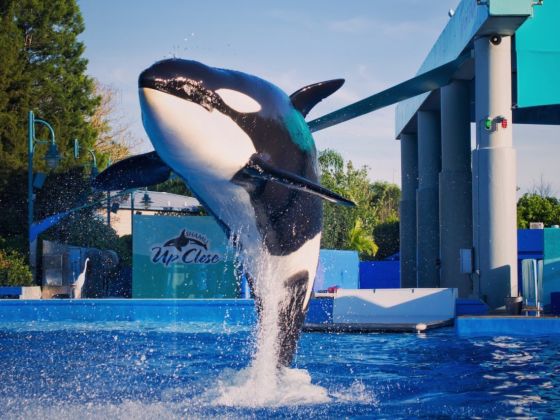
A 12,000-pound orca (killer whale) named Tilikum fatally attacked trainer Dawn Brancheau during a SeaWorld show in February. This was the third human death that the orca has been linked over the last two decades. Animal welfare groups such as In Defense of Animals (IDA) have warned that keeping dolphins and orcas (killers whales) in captivity will inevitably lead to more tragedies.

There was public outcry in Florida, especially by conservative religious groups, to immediately euthanize Tilikum. Tilikum’s fate is still undecided, but apparently the show must go on. Only three days after Brancheau died, SeaWorld resumed its popular whale show, albeit this time with trainers exercising more caution (e.g, giving directions from afar, not swimming with the animals or performing stunts in the water).

Captive Marine Mammals: Weighing the Pros and Cons

What price are we willing to pay to keep intelligent marine mammals captive? Some would argue that visiting amusement parks like SeaWorld is educational. It’s also true that some marine theme parks contribute to endangered species conservation and research. For example, SeaWorld works to rescue and rehabilitate Florida’s endangered manatees before returning them to the wild.

But what public audiences see at SeaWorld shows – dolphins and whales jumping through hoops and performing tricks – is unnatural. Similarly, you won’t see captive marine mammals behaving naturally during popular (and extremely profitable) “dolphin encounters” and swim-with-a-dolphin programs at amusement parks around the world.

Of course, not everyone has that opportunity to see wildlife in the wild, so, is keeping marine mammals in captivity justified?

Some argue that animals born and raised in captivity are not harmed in the same way that those who have been captured from the wild are. But scientific research has shown that marine mammals kept in captivity tend to have shorter life spans than their wild counterparts.

They are also more likely to suffer injuries (e.g., a dorsal fin injured when performing tricks or giving rides to humans) and may become ill from exposure to human disease and bacteria. Positive reinforcement techniques are not always used at marine theme parks, where holding tanks can be shockingly small.

Taking the Next Step (or Not) with Wild Dolphin Swims

Even travelers who agree that dolphins and whales should not be kept in captivity or trained to perform tricks may still defend swimming with wild dolphins.

Photo: TheStoryLady

When I lived in Hawaii, many self-described animal lovers talked glowingly about guided boat tours that took them to swim with wild dolphins, describing it as a “spiritual” experience. Many of these travelers anthropomorphize the dolphins, claiming they looked “happy.” But in fact, the dolphins may have little or no choice about whether to remain in the area or to leave.

Scientific studies have shown that swimming with wild dolphins can be detrimental to their health. When dolphins come into the islands’ protected bays to rest, the presence of humans and motorized boats can be disruptive. Later, when the dolphins swim back out into the open ocean to feed, they may be less able to fend off predators due to exhaustion. Some dolphins may be permanently driven out of safe resting places due to ongoing human disturbance by tour boats.

Is the pleasure of swimming with wild dolphins more important than the harm it might later cause those marine mammals? Perhaps “The Cove” has even more to teach us about ourselves than about Taiji, Japan.

At home and on the road, how do you decide which zoos, aquariums, wildlife tours and other animal attractions to support? How do you make such decisions when you don’t speak or read the local language? Does knowing that a performing animal was born and raised in captivity instead of being taken from the wild make a difference to you? Share your thoughts below.

Community Connection:

Interested in animals? Read more articles from our archives:

Pit Bull Bigotry: Public Perception and Legislation

Wild Pouring Out: Western Oregon’s Wolf Sanctuaries

Photo Essay: The Booming Business of Wildlife Trafficking


    Share

About the Author

Matador ID: sara-benson

Matador community member Sara Benson is a travel guidebook author and former national park ranger. After island-hopping around Asia and the Pacific, she has landed on California’s Central Coast, where she lives with her ranger husband nearby a colony of migratory northern elephant seals. Keep up with her latest adventures on Twitter and her blog, The Indie Traveler.

9 Comments... join the discussion!

  • Elizabeth Eslami replied on March 19, 2010

    What an incredibly balanced, insightful piece!

    I love that you pivot between our good intentions toward these animals (Oscar awards The Cove, demonstrating that the Academy members are humane, concerned citizens; we pay money to swim with dolphins, contributing financially to dolphin conservation efforts) and the negative results of those intentions (Oscar producers shy away from being too “political,” and cut away from the sign; our attempts to appreciate dolphins and orcas ultimately cause them harm.) In the end, it underscores our fundamental inability to understand how to live with animals.

    Thank you for this excellent piece!

    (Report comment)

    ↵ Reply
  • Sara Benson replied on March 19, 2010

    Just wanted to post a link to a recent Science Daily article:

    “Thrill-Seeking Holidaymakers May Be Putting Wild Dolphins at Risk”
    http://www.sciencedaily.com/releases/2010/03/100316191448.htm

    Thanks!

    (Report comment)

    ↵ Reply
  • JoAnna replied on March 19, 2010

    I’m a strong believer in allowing animals to have their space and letting them behave as they naturally would. Humans took over their space; the animals aren’t the ones at fault when they’re forced into unnatural situations.

    I am also okay with organizations that rescue animals who have been injured or are in otherwise dangerous situations if left in the wild IF the point is to rehabilitate and provide a safe space for those animals. In regard to this statement:

    “It’s also true that some marine theme parks contribute to endangered species conservation and research. For example, SeaWorld works to rescue and rehabilitate Florida’s endangered manatees before returning them to the wild.”

    I think that’s great. In fact, I think it’s important. But I don’t think these animals should be subjected to unnatural tricks purely for human entertainment. It’s our own fault (and by our, I mean us as a human society set on being the dominant species) that the SeaWorld incident and similar incidents happen. Animals are animals. If we locked a human up in a cage, his reaction would probably be similar.

    (Report comment)

    ↵ Reply
  • meagantx replied on March 19, 2010

    Thank you for this article! It is so important that we think about these things not only as travelers but in how we want future generations to view nature.

    @JoAnna – loved your last statement…

    (Report comment)

    ↵ Reply
  • Jessica Joy F. replied on March 19, 2010

    There is a big assumption in your article.

    “But what public audiences see at SeaWorld shows – dolphins and whales jumping through hoops and performing tricks – is unnatural.”

    Just because the dolphins don’t behave like that in the wild, does that mean they hate what we do with them? If I lived outside society, I wouldn’t sit at a desk for 8 hours a day– but perhaps I do it because I love the paycheck, and it’s worth it to me. Maybe I even love doing it. I sure wouldn’t have that choice if I had to spend 24-hrs. a day hunting and gathering food, and protecting myself from the elements and enemies.

    Carrying the comparison even further, we could say that a desk-job increases risk of disease and debilitation because of the sedentary nature of the job (just like swimming with the dolphins can be detrimental to the dolphins’ health). But not every desk worker suffers those problems, and certainly desk workers have a much lower risk of traumatic accidents and other life-threatening problems. Does the majority of dolphins suffer from their contact with humans? If so, then why do wild dolphins willingly initiate human contact?

    The assumption is that dolphins and marine mammals in captivity are miserable. As humans, we would be miserable in captivity, right? Once again we are anthropomorphizing… just as much as those who think dolphins are happy because they appear “smiling.”

    (Report comment)

    ↵ Reply
    • Mike Connolly replied to Jessica Joy F. on March 19, 2010

      Your rebuttal is well worded, but also makes some assumptions.

      You write: “The assumption is that dolphins and marine mammals in captivity are miserable.” I agree that misery is not something that can be measured in a non-human animal. But, captive animals do display signs of stress that can be quantified. For example, some captive marine mammals develop stress-related illnesses (gastric ulcers), unnatural swimming behaviors and displays of aggression not normally observed in the wild. There are plenty of scientific studies on these points.

      You also write: “If so, then why do wild dolphins willingly initiate human contact?” Sure, there are occasions when a curious dolphin will approach a human swimmer, for example, a scuba diver. When a pod of dolphins is regularly approached in their habitat by many tour boats, humans are the initiators. That’s why there are federal guidelines in place to safely observe marine mammals from a reasonable distance.

      Your analogy concerning office work doesn’t quite apply to marine mammals that do not have a choice about performing or not. People can always quit their jobs or go on strike. Captive dolphins and whales cannot choose to stop performing.

      (Report comment)

      ↵ Reply
  • Trisha Miller replied on March 19, 2010

    JoAnna I agree with all of your comments, but I do think that, as much as I hate the idea of our takng marine animals out of their natural environment, there is one benefit to such shows……it makes more people care about them.

    People who’ve seen a silly-tricks show at a marine park will care more about the Orcas than those who haven’t. And that caring can translate into easier fund raising when needed to help with lobbying efforts that can keep these animals from being hunted to extinction.

    So, at the risk of exposing the extent of my geekness, to paraphrase Mr. Spock, “the needs of the many outweigh the needs of the one”….or the few….

    (Report comment)

    ↵ Reply
  • Gabriela Garcia replied on March 22, 2010

    Great piece, Sara, that raises some really interesting questions. When I was in Hawaii, I elected not to take a whale watching boat because I had read about how it disturbed the natural process of whale migrations. Then one day I just happened to see them from the shore, and could hear them with my head under the water. It felt far more spiritual than a time I had swam with dolphins in my childhood, mostly because it wasn’t a forced encounter and it wasn’t about me at all, but rather just the natural world unfolding. I am intensely curious about wildlife, but I think there are a lot of opportunities for education and encounters that don’t require capturing animals or forcing them into unnatural situations.

    (Report comment)

    ↵ Reply

Leave a Comment

Get Matador in your inbox and around the web.

Sign up for our FREE weekly newsletter.


View full list of RSS feeds

Jump To Category:


Explore the Community


Popular Stories on Matador

Call for Submissions: Tales From The Frontier of Expat Life

I'm looking for stories about expats exploring the comp... 

Photo Essay: Route 66, The Western Way

Scott Spoleder takes us through Seligman, Peach Springs... 

How to Be Your Own Chai Wallah

Learn the skills of a chai wallah by creating your own ... 

Balloons, Cars, & Nose Blowing: 10 Incomprehensible Fetishes

What bores some stiff gets others that way. You may ne... 

Photo Essay: Everything But the Kitchen Sink

Sink your teeth into these babies (oh yes, we went ther... 

10 Key Destinations For The Historical Time Traveler

If time travel were possible, when and where would you ... 

John Lennon: The Lost 1969 Interview On Peace

38 years after it was recorded, an impromptu interview ... 

10 Drink Recipes You Can Light On Fire

Put a shallow layer of 151-proof rum on top. Light the ... 

The Ten Ugliest Cars Being Made Right Now

If there is a nuclear apocalypse that wipes out all civ... 

How to Make Someone's Day

Sometimes all it takes is a small gesture to turn someo... 


Focus


Blogroll


Editor Blogs