Chevron’s Greenwashing Ad Campaign

05/26/09  Print This Post Print This Post    13 Comments   Popular   Written by Julie Schwietert
    Share
Greenwashing: “when a company or organization spends more time and money claiming to be ‘green’ through advertising and marketing than actually implementing business practices that minimize environmental impact. It’s whitewashing, but with a green brush.”–EnviroMedia Social Marketing
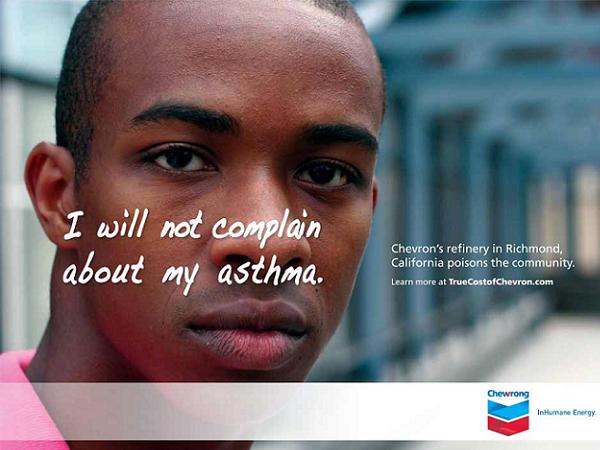
Image courtesy of True Cost of Chevron

Big oil realizes it’s in big trouble.
The world’s big oil companies are in a tough position: they source and sell one of the most in-demand products in a world where consumers are increasingly sensitive to the environmental and human rights impacts of oil production and consumption.

Yet the Chevrons and Shells of the world are responding to market demand and making enormous profits, so there’s little incentive to stop oil drilling.

The oil companies and the consumer public share the responsibility for the consequences of oil dependence on human and physical environments, but big oil is directly on the hot seat. In order to draw attention away from the catastrophes caused by its activities, big oil has been rolling out new advertising and marketing strategies in an effort to change the public’s perception of oil companies AND to put the onus of environmental responsibility on consumers.

Chevron’s recent ad campaign, which revolves around the question, “Will you join us?”, features diverse people in television and print ads making firm, declarative commitments to reducing their own oil dependence:

“I will leave the car at home more.”

“I will finally get a programmable thermostat.”

“I will replace 3 light bulbs with CFLs.”

And so on.

But critics charge that Chevron’s empowering, “I can do it” campaign is little more than the company’s most recent–and boldest–attempt to greenwash its own activities.

In recent weeks, 11 organizations came together to launch the website, True Cost of Chevron. In addition to producing the “Alternative Annual Report,” the activist groups designed their own ad campaign.

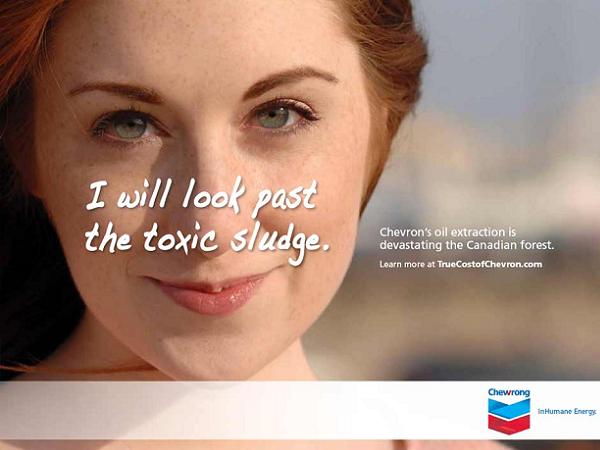
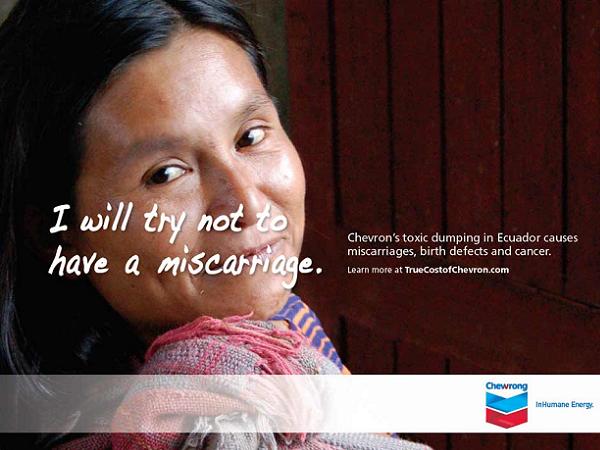
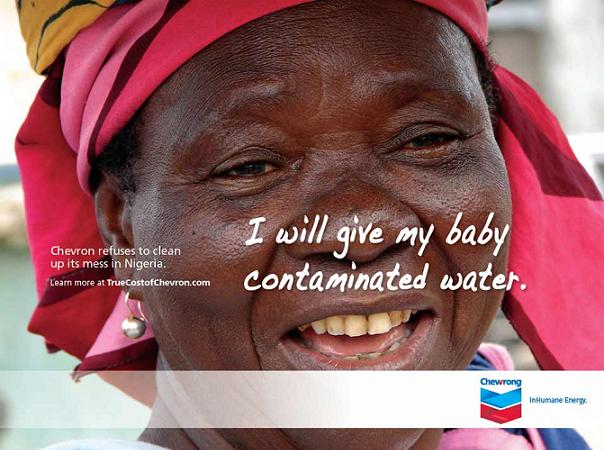
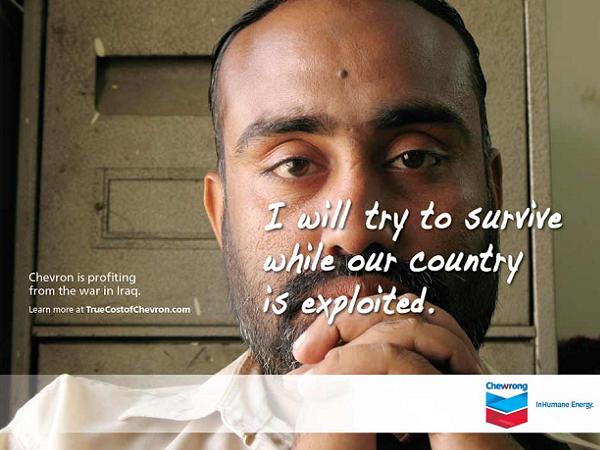
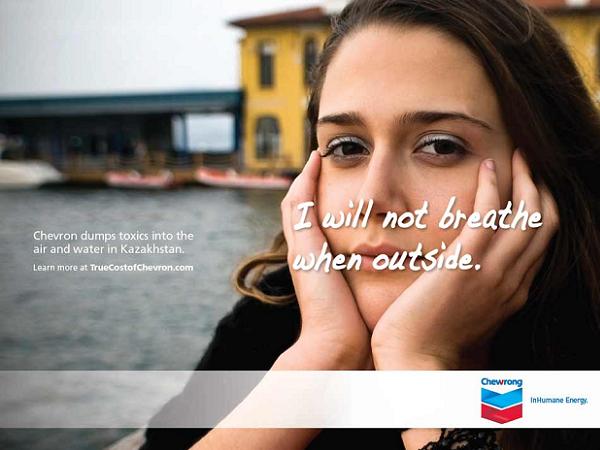
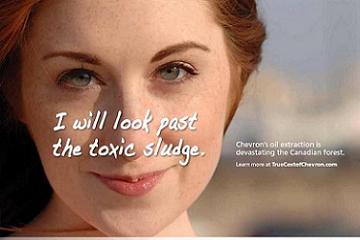
Modeled after Chevron’s “Will you join us?” campaign, the True Cost of Chevron ads also feature individuals from around the world, making aspirational statements of an entirely different sort:

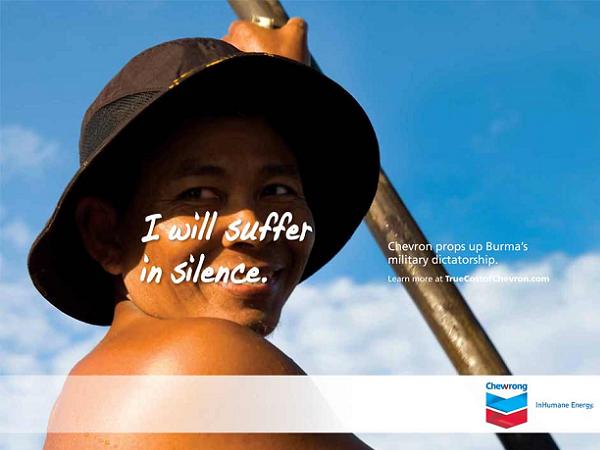
Burma:

Chevron has refused to acknowledge both the widespread human rights abuses caused by its Yadana project and the destructive effects that revenue from the project has had in Burma.

Canada:

In Canada, the toxic burden on communities near the tar sands is already enormous. In addition to direct human exposure, oil contamination in the local watershed has led to arsenic in moose meat – a dietary staple for First Nations peoples – up to 33 times acceptable levels. Drinking water has also been contaminated.

Ecuador:

While drilling in the Ecuadorian Amazon from 1964 to 1990, Texaco – which merged with Chevron in 2001 – deliberately dumped more than 18 billion gallons of toxic wastewater, spilled roughly 17 million gallons of crude oil, and left hazardous waste in hundreds of open pits dug out of the forest floor.

Nigeria:

Chevron continues to employ and pay the notoriously brutal Nigerian military to provide it with security services.

Iraq:

In 2007, Chevron paid $30 million to settle charges brought by the U.S. Securities and Exchange Commission that it had paid illegal kickbacks to the Hussein regime to win its Iraqi marketing contracts, after it was revealed that Hussein had established a worldwide network of oil companies and countries that secretly helped Iraq generate about $11 billion in illegal income from oil sales.

Kazakhstan:

The surrounding populations began to suffer greatly from an unprecedented variety of illnesses upon development of the [oil] fields, including respiratory illnesses, blood illnesses, cardiovascular illnesses, and high levels of stillborn babies, all of which medical specialists have determined to be directly related to the oil industry.

Amazon Watch, one of the organizations in the coalition behind True Cost of Chevron, tried to sell the ads to CBS, which rejected the offer. Within 24 hours, visitors to the True Cost of Chevron site had downloaded the ads and pasted them around San Francisco.

Community Connection:

Want to make sure your money is supporting truly green companies? Check out “10 Brands That Don’t Deserve to Declare Themselves Green” and “10 Tested and True Green Companies.”

All True Cost of Chevron ads courtesy of True Cost of Chevron.


    Share

About the Author

Matador ID: collazo

Julie Schwietert is the managing editor of Matador Network. She contributed a chapter to the recently published book, The Voluntary Traveler, and is currently working on five features for Fodor's Puerto Rico, 6th Edition.

13 Comments... join the discussion!

  • Christine replied on May 26, 2009

    Wow, such powerful ads. Right on for so many orgs to come together to launch these PSAs. It would be great if they could get the kind of money/backing the Truth people have gotten for their anti-tobacco campaign.

    (Report comment)

    ↵ Reply
  • Colin Wright replied on May 26, 2009

    Oh greenwashing. It’s amazing how the spin-doctors in these companies are able to take a bad situation and make it look like they are part of the solution (without being coerced). BP (Beyond Petroleum my foot) and the rest of the oil-ilk are just as bad: are we seriously supposed to believe that these companies are AGAINST the product that they sell? No…they’re really just trying to spread the idea that their company is more eco-friendly that their competitors so they can sell more of what they’ve always been selling.

    Right before I graduated from college in Springfield, Missouri, there was big debate about whether or not to build a new coal power plant in town. To me and most students it seemed like a non-issue…of course you wouldn’t build a new power plant! It’s so archaic! But the company that was building the plant had an incredibly successful campaign, touting their ‘clean coal’ technology and how ‘this is the future of power,’ etc etc etc. In reality, clean coal technology doesn’t really exist on a large scale, and though a lot of power plants are capable of being upgraded, most never will be. Even with the upgrades, the plants would cause major problems for the surrounding areas.

    I just hope the new movements, like Texas wind farms and Southwest solar plants will get enough of a foothold in the US before oil lobbyists and admen are able to paint the old guard with a thin new layer of (green) paint.

    (Report comment)

    ↵ Reply
  • Paul replied on May 26, 2009

    I guess if you’re the 3rd largest corporation in the US then you have to have a huge amount of nerve. Chevron certainly does. Their ads are offensive on so many levels. Everyone I know who has seen them, whether they knew about Chevron’s despicable actions around the globe or not, feels offended by a large oil company telling THEM to conserve. It’s SO much worse when you learn just how bad Chevron ACTUALLY is at respecting people and the environment. I LOVE THESE ADS!

    (Report comment)

    ↵ Reply
  • Nick Rowlands replied on May 26, 2009

    These ads are fantastic!

    I think the Burma one is particularly emotive: “I will suffer in silence”.

    With the exposees of collaborations such as The True Cost Of Chevron, and articles like this promoting their hard work, there’s no longer any excuse for our silence, or the suffering that it tacitly promotes.

    Spread the word: it’s time to shout.

    (Report comment)

    ↵ Reply
  • Ross replied on May 26, 2009

    Loved these parody ads!

    I’ve despised this “will you join us” campaign since it began and it seems to be everywhere! It would be amazing to see these up on massive billboards in major US cities.

    (Report comment)

    ↵ Reply
  • Carlo replied on May 26, 2009

    I love the Chevwrong symbol. Thanks for this Julie, and for what’s about to come. Truly important stuff.

    (Report comment)

    ↵ Reply
  • Tim Patterson replied on May 26, 2009

    The funny thing is that the Chevron greenwashing ads are being placed in publications that do a good job of exposing the true danger of our reliance on fossil fuels. I see tons of Chevron BS in The New Yorker, for instance, which runs lots of features by the extraordinary climate change journalist Elizabeth Kolbert.

    On a similar note, how about those Coal lobby ads that are all over nytimes.com? America’s Power my ass.

    Agree that the Burma ad hits especially hard.

    (Report comment)

    ↵ Reply
  • Alan replied on May 26, 2009

    Nice ads. If only these oil companies would have spent that money repairing the crap that they caused, or prevented it all together. The positive publicity would have followed soon after. Tsk, tsk.

    (Report comment)

    ↵ Reply
  • Michelle replied on May 26, 2009

    Great ads. Like Paul said, it is rather arrogant of them to ask others to be more green. Sad that they spend more money telling people to do so than they do on actually being green themselves.

    (Report comment)

    ↵ Reply
  • Pat the Digital Vagabond replied on May 27, 2009

    “Green Washing” – now I finally have the words to describe this irritating phenomenon. Big oils TV ads/spin always irked me. Julie, your article helped me put my finger on why. Nice work. The parody ads reminded me of the work that the magazine “Ad Busters” does in parodying the hypocrisy of media spin in our world.

    (Report comment)

    ↵ Reply
  • Jessica replied on May 16, 2010

    I’m a college student in China.Recently, I’ve been working on a report about greenwashing and the company I choose is Chevron. Actually, the oil companies like BP and Shell are all kind of greenwashing. They advertise that they are envrionmentally friendly or they are investing great amount of money on the alternative energy, but in fact, the money is less than enough or just because the law forced them to. I think it is very flagitious because the consumers who watch the ads might think that the oil comnies really make a contribution to the envrironmental sustainability and they may feel less guity than before. That’s unfair!

    (Report comment)

    ↵ Reply

Leave a Comment

Get Matador in your inbox and around the web.

Sign up for our FREE weekly newsletter.


View full list of RSS feeds

Jump To Category:


Explore the Community


Popular Stories on Matador

Experience the Art of Improv Travel

Travel is more about how you do it, not where you go. F... 

Infographic: Health care around the world

American health care reform? See just how much it was n... 

Urban Homesteading: Turn Your City Home Into Country Living

Who says you can't have a farm in the backyard of your ... 

4 Ways to Welcome Your New Baby to the World

Start with these ideas and make them your own. ... 

The Future of Freelance Journalism, Part 1

Notes, quotes, tweets, links and other distractions fro... 

Carbon Footprint of US Junk Mail Equivalent to 480,000 Cars

The average person in the US receives 11 pieces of junk... 

Pakistani Politics: Why Women's Voices Matter

Violence in Pakistan dominates the headlines. But rarel... 

Photo Essay: Wreck Diving in the Great Lakes

Diving in the Midwest isn’t as glamorous as diving in... 

Friday Fun: The One Hit Wonder Down Under

The snow’s long gone in the northern hemisphere, but ... 

The World's 12 Most Spectacular Houses of Worship

Eva Holland rounds up holy buildings that offer a power... 


Focus


Blogroll


Editor Blogs