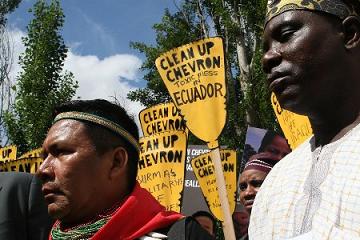
An Open Letter to America

05/27/09  Print This Post Print This Post    12 Comments   Popular   Written by Emergildo Criollo
    Share
Emergildo Criollo Quenama, a leader of the indigenous Cofan of Ecuador’s Amazon, writes an open letter to Matador readers, to Americans, and the world in which he shares his experiences living with the direct effects of Chevron’s environmental and human rights abuses.
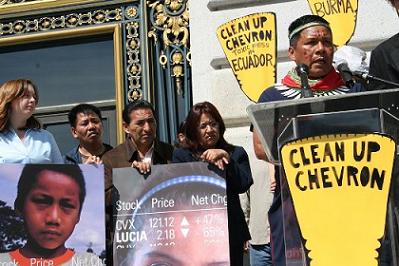
Emergildo Criollo

Avujathse gi ke’ima chiga’bian puiyi’ccu EE.UU suma.
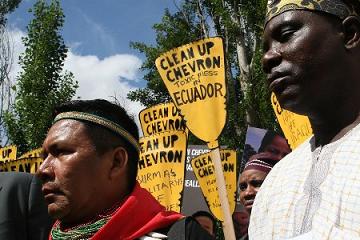
Nanda gi Emergildo Criollo pui aindeccu kankhene a fasu.

Va tsu a’ingae.

Ja’nu gi va San Francisco kanjen tui gi cundaseya mingae amazonia’su a’indeccu Chevron tson’jen’chune.

I send a cordial greeting to the citizens of the United States in my native language.

My name is Emergildo Criollo, and I am a representative of Cofan village. Today, I am in San Francisco [California] to participate in the annual meeting of Chevron, where I will let the public know the truth about what has happened in my territory since Texaco initiated its operations in the Ecuadorean Amazon, as well as the history-making lawsuit that we are leading in pursuit of justice after 15 years.

The village of Cofan is located along the banks of the Aguarico River. When I was a boy, we drank clean water and hunted animals in the forest. We fished in the river, which was uncontaminated. Before, we lived free of pollution. We had enough food for our families, and enough natural medicine from the forest. With these medicines, we cured illnesses as we’d always done, according to our traditions. But with the arrival of Texaco in 1964, we could no longer use these medicines because new illnesses began to appear as a result of contamination.

It was in 1969 when I saw an oil spill for the first time, which soon flowed into the Aguarico River. Seeing this, we–the members of the Cofan–could no longer live there because there was no place to source clean water. So we moved further into the forest, establishing what is known today as the community of Cofan Dureno.

But the company pushed farther and farther into the forest, drilling more oil wells. We even had a well, Dureno 1, which was inside our own community. That well affected our people tremendously. There were spills and massive water accumulations. The flames of refinery towers were visible day and night. Animals abandoned the forest and fish disappeared from the river.

It was in 1969 when I saw an oil spill for the first time.

My two sons died drinking contaminated water. My aunt died of mouth cancer. She also drank contaminated water.

The company is to blame for all of the contamination. They must take responsibility for their actions and begin to clean up the contamination that still exists.

The five nationalities–Siona, Secoya, Kichwa, Huaorani, y Cofán– have organized.

Even now, the people from each of these groups continue dying from cancer. It’s for this reason that I write this letter- so you know how Texaco (now Chevron) affects people with its petroleum operations.

The company entered the Amazon without anyone’s permission, destroying the forest and leaving contamination and unknown illnesses in their wake. Today, the company is hiding the truth, saying that oil spills haven’t caused contamination and that they’re not cancer-causing agents. But I know that’s not true because this illness was never in our community before. And I know that my two sons and my aunt would still be alive today.

I invite all of you to visit the Amazon…[S]ee for yourself….

Chevron must take responsibility for cleaning up the open pools and sediments in the ground water supply so that my children can drink clean water and breathe clean air. Chevron took natural resources from the Ecuadorean rain forest, but those of us who live here have only received contamination, sickness, and death.

Everything the company says is totally false. I know because I’ve seen and experienced the effects of their actions first-hand. Texaco, now Chevron, wants to maintain a clean image. But for me, the image of this company is stained with oil.

I invite all of you to visit the Amazon where Texaco operated. You can see for yourself. You can see firsthand the contamination. You can say so to Chevron and demand that they accept responsibility.

Today, I’ll be entering Chevron’s headquarters to attend the annual meeting of the company’s shareholders. I’m going to talk face-to-face with the company. I’m going to defend my village and demand justice.

I ask the citizens of the United States to join with the 30,000 residents of the Ecuadorean Amazon in solidarity.

We have been fighting for more than 15 years for the company to clean up the damage it’s done to the environment.

And we’ll keep fighting until the end.

Translated from the Spanish by Julie Schwietert Collazo. To read the original version of this letter in Spanish, click here.

Community Connection:

To learn more about what’s going on with big oil this week, check out this article. And to learn how Chevron’s putting responsibility on consumers (and not the company), read about the company’s most recent greenwashing ad campaign. Finally–and most importantly–to learn how YOU can take action, please visit ChevronToxico.


    Share

About the Author

Emergildo Criollo

Emergildo is a leader of the Cofan indigenous people—the indigenous group whose pristine rainforest territory became ground zero for Texaco’s dirty oil operations. He was born in the community of Dureno in 1959. He is the oldest of 9 children and with his wife has four children of his own. Emergildo has been a key force is maintaining the Cofan’s cultural traditions and thwarting new drilling efforts by other oil companies seeking to drill on their lands.

12 Comments... join the discussion!

  • david miller replied on May 27, 2009

    for how many centuries has this same thing gone on?

    the only thing that seems to change are the names of the conquistadors and the way they lay claim to and exploit the land.

    who will step up and do something about this?

    (Report comment)

    ↵ Reply
  • Christopher Earle replied on May 27, 2009

    An incredible letter. Unfortunately, I think the people who read this are likely people who are already aware of the detestation that American lifestyles levy on other places and people. What is frustrating is that the people using the resources mock the victims and those of us who try and change the status quo. The perpetrators are either unaware or feel that people outside of the United States are less “human” than people inside the United States. To them, the lower economic classes are unimportant and in place for their exploitation. Justice will not be done until the the perpetrators suffer the same destruction as the rest of the world or when the common people reach critical mass and, as has been happening in Bolivia and Venezuela, eject the exploiters.

    (Report comment)

    ↵ Reply
  • Hal replied on May 27, 2009

    Thanks so much to Emergildo for this. So important to hear the story from the source.

    (Report comment)

    ↵ Reply
  • Lou replied on May 27, 2009

    While I can’t argue that the atrocities committed in the Amazon are a disgrace and wrong. Yes. Someone needs to take responsibility. But when an article begins wiht something as:

    “since Texaco initiated its operations in the Ecuadorean Amazon”

    The problem with this letter and this piece is that it wasn’t Texaco (Chevron) that initiated the oil exploration. It was the Nationalized Ecuadorian gas company PetroEcuador. There are two companies involved here. Shared responsibility.

    By isolating an attack on one company without acknowledging the other is just as bad as one pointing a finger at another. It’s a shared responsibility.

    Let’s look at all the facts and have ALL those involve, including contractors hired by either firm in Ecuador, act socially responsible and clean up the mess and make good to the people. It shouldn’t be only the firm with the deepest pockets.

    (Report comment)

    ↵ Reply
    • Julie Schwietert replied to Lou on May 27, 2009

      Lou-

      Thanks for your comment. If you look at the history of petroleum in the Americas, even when local or national companies “own” a share of oil profits (and, therefore, responsibility for human & environmental hazards), they were often backed–overtly or otherwise–by US and European oil interests. In other cases, they merely inherited (or bought out) foreign oil companies’ infrastructure that had already left a trail of problems behind it. So I don’t think that pointing the finger back at PetroEcuador necessarily tells the whole story.

      (Report comment)

      ↵ Reply
  • Paul replied on May 27, 2009

    I have traveled with Emergildo to see the waste pits as he requested. I will never be the same after seeing the destruction and visiting the communities still suffering. Emergildo has paid the ultimate price for Chevron’s actions. It might just as easily have been my small son sick and dying from the pollution. I am so saddened by Emergildo’s loss and I will continue fighting with him until he and the affected communities achieve justice. Thank you, Emergildo!

    (Report comment)

    ↵ Reply
  • Carlo replied on May 27, 2009

    Extremely moving. Thank you for sharing your heartbreaking story. Best of luck in San Francisco, Emergildo!

    (Report comment)

    ↵ Reply
  • Christine replied on May 27, 2009

    So utterly and completely powerful. Thank you.

    (Report comment)

    ↵ Reply
  • Tim Patterson replied on May 28, 2009

    Thanks for this powerful and articulate message.

    (Report comment)

    ↵ Reply
  • nick replied on May 28, 2009

    Thank you Emergildo Criollo Quenama, for sharing your story. You show incredible determination and resolve in working for justice against one of the worlds most dangerous corporations, Chevron. I, of one will stand in solidarity with you and the other 30,000 Ecuadorians living with the consequences on Ecuador’s operations. Thank you for your strength and vision.

    (Report comment)

    ↵ Reply
  • Shreya replied on May 28, 2009

    Searingly honest and courageous. Thank you so much for sharing this.

    (Report comment)

    ↵ Reply
  • neha replied on May 29, 2009

    This is the story of the world, isn’t it? Towns and villages disintegrating while Governments and private companies pile on the profits. I hope this story is heard and a difference is made.

    (Report comment)

    ↵ Reply

Leave a Comment

Get Matador in your inbox and around the web.

Sign up for our FREE weekly newsletter.


View full list of RSS feeds

Jump To Category:


Explore the Community


Popular Stories on Matador

A Virtual Ride On A Chinese Train

Slowly the train wakes up around you. People stumble wi... 

Someday Syndrome & the System of I-Can’ts

Or why I left my five year old standing in a raging riv... 

The Cenotes of Riviera Maya, Mexico

Contributing editor Juliane Huang discovers why she nev... 

Pakistani Politics: Why Women's Voices Matter

Violence in Pakistan dominates the headlines. But rarel... 

America's Largest Climbing Gym Opens in Atlanta

Stone Summit has over 30,000 square feet of climbing su... 

How Climbers Can Help Pakistan Rebuild

A senior official at the Red Cross has said that rebuil... 

A Meditation On Washing Dishes

Dirty dishes: the ultimate symbol of household drudgery... 

Impossible Music Is Not Quite Impossible

The Impossible Music Project gets artists censored by t... 

Could Running Barefoot Be Good For You?

A study published this week suggests that runners who g... 

Beginner's Guide to Dumpster Diving

In some places, dumpster diving is a means of survival.... 


Focus


Blogroll


Editor Blogs