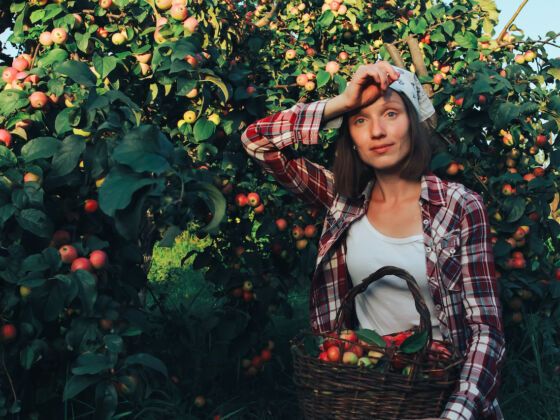
Feature photo: www.worldon2wheels.com; Photo: emma.maria
In response to my question about how many hours a day the WWOOFers worked, the host replied, “We expect the WWOFers to enjoy the work enough not to mind how many hours they work.”
A red flag should have begun waving itself madly, but all I could see was the cheese factory on site, the fact they made their own pasta, and the assortment of animals on the farm. I ended up working about 12 hours a day on that farm, but never with the cheese or the pasta.
After having good and bad experiences WWOOFing in four different countries, these are the questions I’ve learned to ask:
1. How many hours do I work each day?
The purpose of this question is to be prepared for the expectations of the farm. The answer also gives you a reference point for addressing concerns if you find a significant discrepancy once you’re at the farm.
Asking about days off is also a good idea. One guy arrived at a farm and thought he had every weekend off. He was unpleasantly surprised to learn this was not the case.
2. What kind of work will I be doing?
Photo: strikeael
I always like to know there is a variety of work to be done. At one farm I never did the same thing twice; I faced new challenges like milking goats and making a basket out of willow.
At another farm I only did two things: herd goats and cut grass. Which one do you think I enjoyed most? This question is important because you can find out if the work will suit you physically and if the tasks offer the experiences and challenges what you want.
3. I only speak English. Does that matter?
In France, I WWOOFed at a host who had moved from England, so language was not a problem. In Italy, however, I encountered a few problems at two farms. The first host did not like speaking in English. Instead, the host spoke to the other WWOOFers who spoke Italian, never directing anything to me.
Photo: strikeael
Their listing had indicated English was spoken, but it was a quiet and unsocial two weeks. At the second farm there was frequent miscommunication because the host spoke little English and was impatient with misunderstandings. Better to be clear from the start!
4. Do you allow WWOOFers to use the internet?
WWOOFers are often travelers who want to stay in touch with family and be able to make further travel arrangements. Yet I was surprised by the number of farms that were unhappy to let me send a quick email or look up a train schedule.
Some people are simply of an earlier generation, don’t use the internet themselves, and don’t see why you should. Others have had bad experiences of WWOOFers using their computers. Either way, if you plan to stay connected, it’s wise to ask about the host’s policy.
Make sure you leave for a host prepared; otherwise, unpleasant surprises might take away from what could be a rewarding experience.
Community Connection:
Read some other practical tips in our First-Timer’s Guide to WWOOFing.
About the Author
Related Posts
16 Comments... join the discussion!
-
-
Good article for us, thanks for sharring^^
↵ -
Good to know; I’ll keep these in mind when I check out farms in New Zealand.
↵ -
Thanks for the tips!
↵ -
I especially agree with your second point. When I was WWOOFING in Australia they forgot to tell us babysitting was part of the job, I did not see that one coming! Something else I would like to know before going is if you will be the only WWOOFer there, or not. If the placement where you’re staying is very remote, and you don’t speak the language, it might be quite hard to have only yourself to talk to…
↵ -
i’m about to dive into my frist WWOOFing xperience in New Zealand…
thanks or sharing this!!
↵ -
all valid points! i am buzy setting up to receive wwoofers, i have an awsome spot in south africa kzn, 5min from the beach, that covers all the bases. loads to do in the area. all wwoofers welcome! we grow aloes veg, mushrooms, an loads of others. see you all soon an keep it organic!
↵ -
The wife and I just completed a 3.5 month stint on an amazing garden farm in Maui, Haleakuagardenfarm.com and these tips are dead on. We also had NVC classes in Non-Violent Communication, extra cleaning duties, shopping trips and work related meetings to add to our schedule… so do ask questions before you go! We also started out camping in tents there and were upgraded to a room once the major rains started here, so ask if indoor accomodations are available too.
Food is an issue so do make sure you can harvest from the farm or have a weekly budget for food bought in local markets. Enjoy and check out my Wwoof’ing pictures at http://www.jradimages.com
Mahalo,
Jared↵ -
I agree with all of the above. It’s really important to share your thoughts with your country Wwoof coordinator – I had a really bad experience in Puglia – basically left on my own in a very isolated place for a couple of days.
I contacted the coordinator who checked it out and the place was removed from the list.I like Help X because you can read about other people’s experiences and you can also leave feedback for others. I think that would improve the Wwoof experience.
Having said all of that my suggestions are: remember that you are in someone else’s home/space; be flexible, take advantage of the great opportunities presented.
There was one place that didn’t have electricity – but it was one of the best experiences, there was another place where we worked long days but I made a very good friend. So think of it as swings and roundabouts.
Oh how I miss it!
↵ -
Verry good article for all future WWOOFer! Can you tell me in wich place you had a bad experience and don’t recomend us to go. And maybe a place where you liked. Thank you.
↵ -
From the perspective of a small garlic farm in northern New Mexico that has hosted lots of Wwoofers for the last 10 years or so:
1. How many hours per day? I have almost always described what I am offering as a place to stay (very small one room adobe with electricity, drinking water frost free hydrant 35 feet away, outhouse) in return for three 8 hour work days per week with a $100 per week stipend.
2. What kind of work? Depends a lot on the season: For example(s) in February and early March, mostly ditch digging/cleanup on the field ditches or main acequia; April/May first weeding, lifting the mulch, raking out elk tracks, irrigating (flood and sprinklers), raking and chicken composting leaves, the first weeding, spraying fish emulsion; June weeding and irrigating; July harvesting, cleaning, sizing, hanging garlic bundles, weeding; August/September irrigating, weeding, stacking alfalfa and grass hay; October planting garlic: discing, furrowing; November putting it all to bed and cleaning up for the winter; January fence repair.
3. Mostly English but we both speak Spanish pretty well and I am fluent in French.
4. Internet use: we have airport express in the main house. If you have a laptop, you are welcome to use the connection in moderation. We do sometimes resent when a wwoofer begins serious internet use looking for the next place to go before they have learned how to use, return to their place and take care of the tools after saying that they would be here for at least a month. Especially when they begin to ask to use the phone 3-4 times a day! Our phone is not really part of the deal.Maybe that is a viewpoint you can use?
↵ -
“If you have a laptop, you are welcome to use the connection In moderation” and “our phone is not really part of the deal” are two phrases that would cause me to run far, far away from your listing.
Also, if your perception of somebody’s performance influences how you feel about their use of your communications devices- presumably the only ones that a wwoofer would have access to- then that is an ugly can of worms, indeed.
↵ -
Hey! my husband and I are checking out WWOOFing options in South Africa for June. I’d love to know more about your opportunity.
↵ -
Those questions are absolutely the right ones to ask, and a great start, but so many things are impossible to know or predict before actually arriving at a site. Jobs change due to weather or other unforeseen circumstances, some hosts simply aren’t very honest with themselves about their expectations of wwoofers, and there will inevitably be hosts that you simply don’t get along with, for one reason or another.
Thus, you should ALWAYS have a plan for leaving a location at any time, and not feeling bad about it. If you have a decent, straightforward reason for leaving (e.g., the particular work you are doing is boring and unrewarding), then your hosts should understand. If you don’t, then that’s ok, too. If you don’t feel comfortable talking to your hosts about why you want to leave, then that is a clear sign that you should go.
While it is important to work hard and appreciate the hospitality you receive at a site, you should never feel obligated to stay for any reason. After all, you are ultimately the one subordinating your habits and lifestyle to mesh with theirs. There are so many great hosts out there that there is no reason to waste time in an uncomfortable situation.
↵ -
The bad place was in Italy, but myself and the other wwoofer both reported it to the country coordinator and it was taken off the list. So you don’t have to fear ending up there.
An awesome place was the Garn Farm in Herefordshire, England. Amazing family and gorgeous location.↵


